
A Debate Often Framed Wrong
In recent years, the debate around developing insurance in Africa has repeatedly circled back to a single observation: a lack of capital. Yet a closer look at some insurers' balance sheets, particularly life insurers on the continent, reveals an incomplete picture. Reserves exist, assets exist too, but a large share of this capital remains locked in relatively passive portfolios today, with limited capacity to support the sector's transformation or new growth dynamics.
In other markets, these same balance sheets are used far more actively. They are used to release regulatory capital, reallocate resources toward higher-value activities, or more efficiently absorb certain long-term risks. The issue, then, is not solely the availability of capital; it is also about how that capital is structured, mobilized and deployed within the insurance economy.
This is precisely what makes funded reinsurance particularly relevant in the African context.
A recent signal illustrates how far the topic has advanced elsewhere: the Bank of England is considering tightening prudential requirements applicable to certain funded reinsurance structures — proof that these mechanisms have now reached a scale and sophistication sufficient to become a genuine financial supervision topic. In some markets, the debate is no longer about understanding these structures, but about their prudential framework and systemic implications.
The Current State: A Global Market Taking Off
Funded reinsurance is not an emerging or experimental concept. It is already a central tool in the balance-sheet management of major insurers, particularly on life portfolios. The principle is simple in its architecture but powerful in its effects: the insurer transfers to the reinsurer not only the risk but also the assets backing its liabilities — or, in certain structures, keeps those assets while transferring the economic risk. Either way, the logic stays the same: risk is externalized, capital is freed up, and the balance sheet becomes a lever for transformation.
Global capital dedicated to reinsurance has reached a record level, surpassing $800 billion. In parallel, alternative capital, notably through capital markets, now exceeds $100 billion.
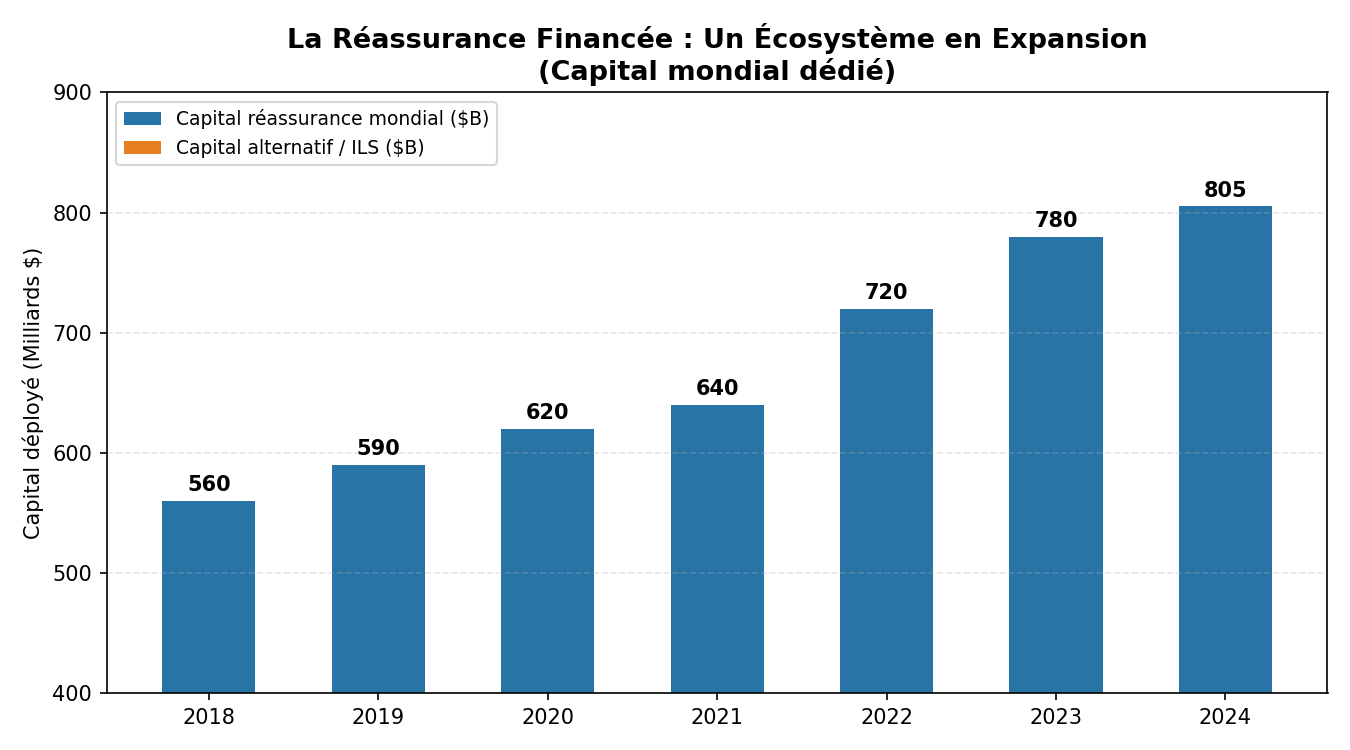
Hubs such as Bermuda have become genuine centers of gravity, absorbing massive volumes of life liabilities, notably from the United States. Players such as RGA have built a significant share of their growth on these transactions. Elsewhere, funded reinsurance has thus become a structuring tool: it optimizes capital and redeploys resources toward higher-value activities. It is a mature, sophisticated market in structural growth.
Why It Works So Well
Funded reinsurance solves a fundamental problem: how does an insurer shed economic risk without breaking its relationship with policyholders? In a classic portfolio transfer, policyholders change counterparty — a process that is slow, costly, and creates significant reputational risk.
In funded reinsurance, the mechanics are different:
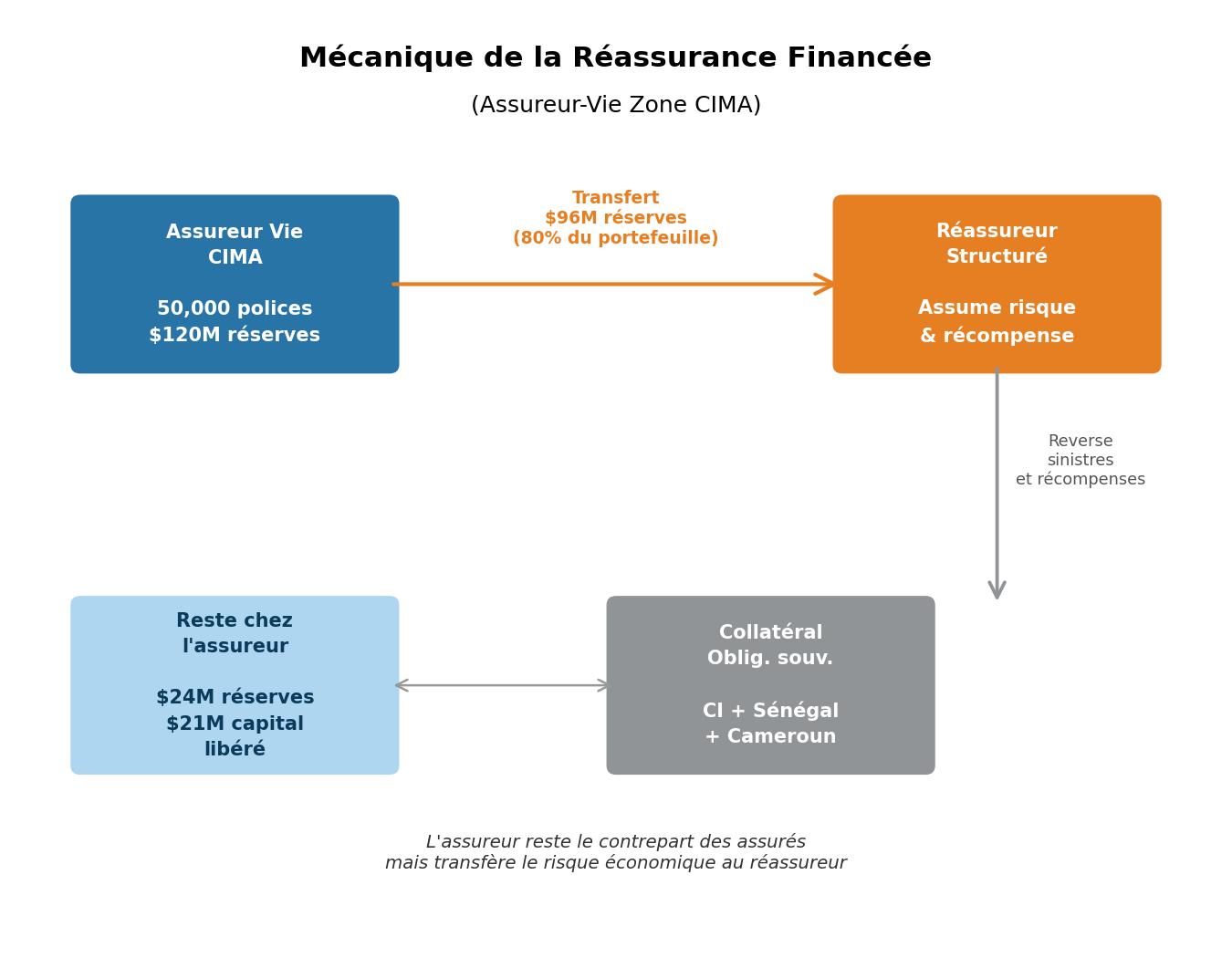
- The insurer remains the policyholders' counterparty.
- It transfers the assets backing the reserves to the reinsurer.
- The reinsurer assumes the risk and passes claims and profit-sharing flows back to the cedant as they arise.
- The insurer frees up regulatory capital and can redeploy it toward higher-value activities (growth, distribution, innovation, micro-insurance).
It is reinsurance, but with a deep financial dimension: the reinsurer becomes an asset manager and risk absorber at the same time. The cedant transforms from a "risk holder" into a "distributor and customer-relationship manager."
The African Shift: Why Now Is the Moment
Applied to Africa, this contrast becomes hard to ignore. The debate around developing the insurance and reinsurance sector on the continent very often returns to the question of a lack of capital, as if that alone were the main constraint on market growth. This reading looks increasingly incomplete, especially as Africa is progressively becoming a genuine launchpad for large infrastructure, energy, transport, telecommunications and industrial transformation projects — driving a significant rise in coverage needs and insurance and reinsurance premium volumes.
The capital is there. Reserves exist and build up year after year. And yet, a large share of this capital remains locked in place.
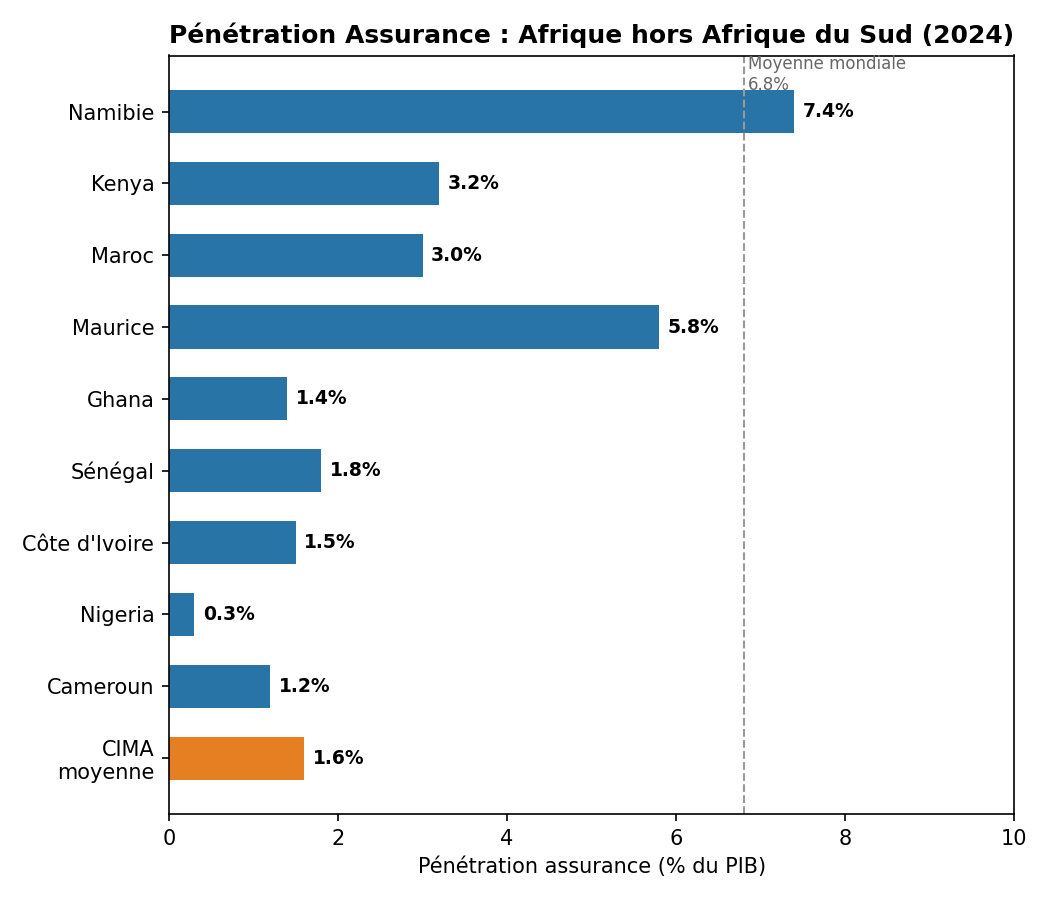
In many markets, insurers adopt investment strategies that severely limit transformation capacity. What stands out is not the absence of resources, but how they are used. While other markets treat their balance sheets as levers, much of the sector in Africa remains in a conservation mindset. The result is visible at several levels: insurance penetration stays low, often below 2% of GDP in many countries; underwriting capacity is limited; and a significant share of large risks continues to be reinsured off the continent, resulting in significant value leakage.
This is where the topic becomes interesting: funded reinsurance does not "bring in" outside capital; it reorganizes what already exists — turning static reserves into a dynamic lever, freeing up capacity, and putting motion back into balance sheets that are currently underused.
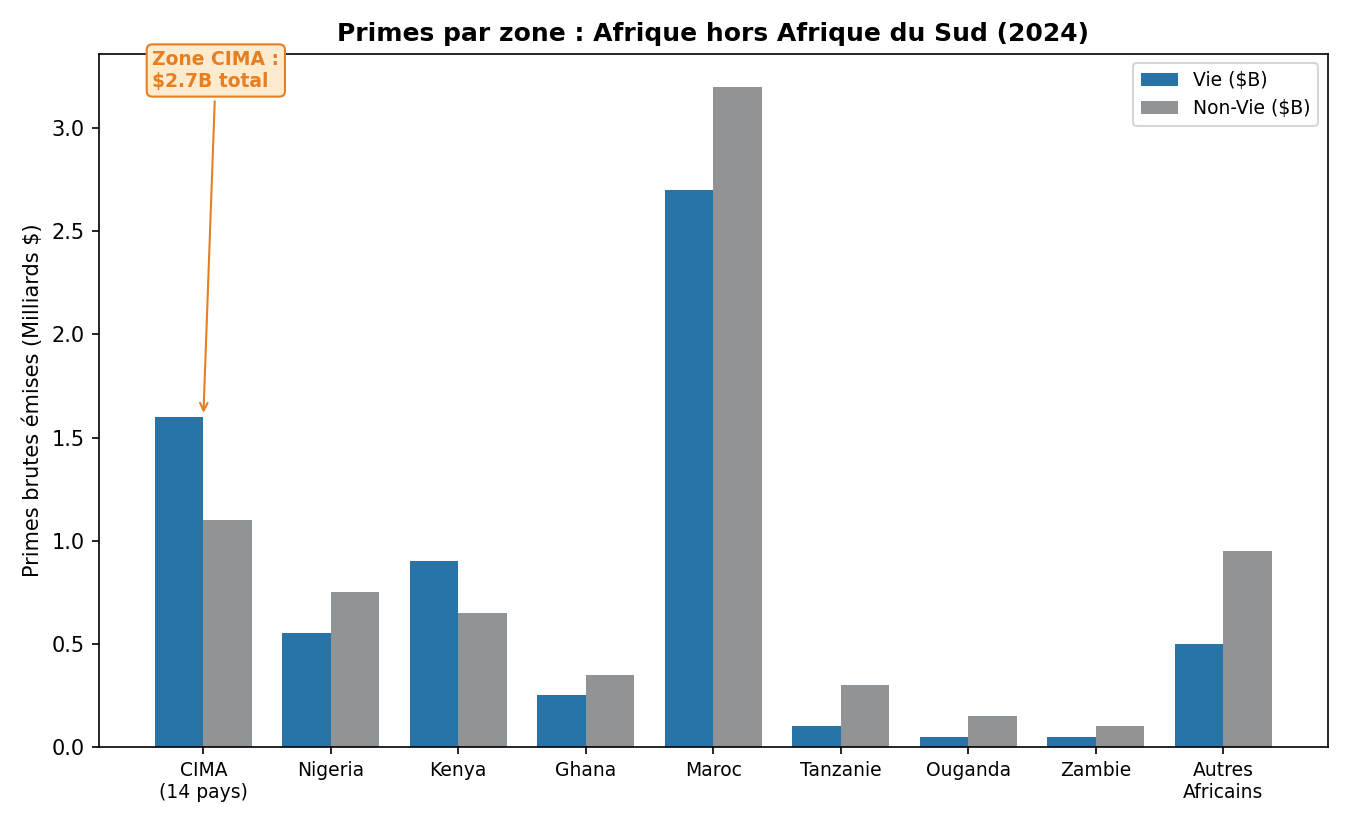
As an illustration: $3.5 billion in African capital structured through funded reinsurance, for the CIMA zone and Kenya alone (mobilizing just 15 to 20% of reserves), would represent nearly double the CIMA zone's current total life premium market. This is not marginal innovation. It is potential structural transformation.
An "As If" Case: What a Transaction in the CIMA Zone Could Look Like
The case below is a simplified model for purely illustrative and educational purposes. The assumptions used are inspired by characteristics observable in certain African markets, without corresponding to any specific existing company, transaction or structure.
Imagine a life insurer based in the CIMA zone, with a mid-sized portfolio representative of the market: around 50,000 policies, an average annual premium of about $400, i.e. roughly twenty million dollars collected in premiums each year. With this type of life portfolio, reserves naturally build up — landing in the order of $120 million in mathematical reserves, backed by assets invested mostly in local markets. The balance sheet is healthy: equity is around $40 million, for a comfortable but not excessive solvency ratio of around 130%.
Base portfolio (indicative calculations):
| Parameter | Calculation | Value |
|---|---|---|
| Number of policies | — | 50,000 |
| Type | Term-life / savings-life mix | — |
| Average annual premium | — | $400 |
| Premiums collected / year | 50,000 × $400 | $20 million |
| Technical rate | Set by CIMA | 5% net |
| Mathematical reserves | 6 years of capitalized premiums | $120 million |
| Total assets | 80% CIMA bonds + 12% equities + 8% cash | $160 million |
| Equity | Assets − Reserves | $40 million |
| Required SCR (solvency) | CIMA regulatory requirement | $30 million |
| Solvency ratio | Equity / SCR | 133% |
The 50,000 policies and $400 average premium are representative of a mid-sized insurer in Côte d'Ivoire or Senegal. The 5% technical rate matches CIMA-zone practice. Reserves at 6 years of capitalized premiums follow a standard rule of thumb for mixed life portfolios. The $30M SCR corresponds to roughly 25% of reserves, a common conservative ratio in francophone Africa.
Now, what happens if this insurer sets up a funded reinsurance transaction? It decides to cede a mature portion of its portfolio — say 80% — to a structured reinsurer, transferring around $96 million in reserves in the form of assets.
Estimated impact:
| Line item | Before | After | Impact |
|---|---|---|---|
| Remaining reserves | $120M | $120M × 20% = $24M | −$96M transferred |
| Portfolio SCR | $30M | $30M × 20% = $9M | Risk reduced proportionally |
| Counterparty-risk SCR | $0 | $3M | Stress on reinsurer collateral |
| Total SCR | $30M | $9M + $3M = $12M | −60% capital requirement |
| Equity | $40M | $40M + $2.4M ceding commission = $42.4M | +$2.4M ceding commission |
| Solvency ratio | 133% | $42.4M / $12M = 353% | +220 points |
Why does the ratio climb so much? Because the insurer keeps its equity (it hasn't lost money — it transferred reserves against an equivalent premium), but its solvency capital requirement collapses: market risk is now borne by the reinsurer, and only a residual counterparty risk (in case of reinsurer default) remains to be covered.
Even factoring in prudential adjustments, the improvement remains very significant and repositions the insurer, which ends up with roughly twenty million dollars of freed-up capital — redeployable to raise the insurance take-up rate, launch new products, invest in parametric solutions or finance local projects. The insurer no longer merely carries liabilities: it becomes an active agent of economic transformation, positioned to move the needle on life and non-life insurance penetration.
Why the CIMA Zone and Kenya Are Relevant Laboratories
The CIMA zone (14 countries):
- A harmonized regulatory framework: the CIMA Code offers unique terrain. A single regulatory approval could theoretically open 14 markets.
- Dormant reserves: roughly $4 to 5 billion in cumulative life mathematical reserves, mostly invested locally at low yield.
- A latent lever: Côte d'Ivoire and Senegal already issue international bonds (Eurobonds). These same instruments could serve as collateral in funded reinsurance structures.
Kenya:
- East Africa's insurance innovation hub: M-Pesa proved that Africa can "leapfrog." Kenya can do the same in insurance.
- A proactive Capital Markets Authority (CMA): Kenya has already experimented with green bonds and sukuk. Funded reinsurance can be seen as a logical extension.
- Abundant local investment funds: Kenya has more than 20 pension and mutual funds, all potential investors in structured funded-reinsurance vehicles.
Innovate, Don't Copy
The US and UK model rests on mature ecosystems: a strong actuarial profession, sophisticated regulators, deep capital markets, rating agencies, harmonized accounting standards (IFRS 17, etc.). The CIMA zone and Kenya cannot simply copy-paste this model. Instead, there is a disruptive path to build — comparable to what Kenya did with mobile telephony.
Conclusion: A Strategic Challenge, Not a Technical One
At its core, funded reinsurance is not a topic reserved for a handful of mature markets or sophisticated structures. It is a logic — a different way of reading a balance sheet, of thinking about capital, and of considering the insurer's role in the economy.
In Africa, the ingredients are already there. The portfolios exist. The reserves have built up. The needs are obvious in terms of inclusion, infrastructure, and risk coverage. What is missing today is not the raw material: it is the structuring. And that structuring will not come solely from outside — it will be built locally, by the insurers, reinsurers, regulators and investors who decide to evolve their models.
The question, then, is not whether funded reinsurance has a place in Africa. The question is who will take the initiative to structure it — and how fast.