
Ten years after the CIMA reform, where do we really stand?
In 2016, when CIMA announced its ambitious reform of the regulatory framework, I was convinced it would mark a decisive turning point for the insurance sector in French-speaking Africa. The goal was clear: a better-capitalized sector, better retention of premiums within the region, and greater regulatory harmonization.
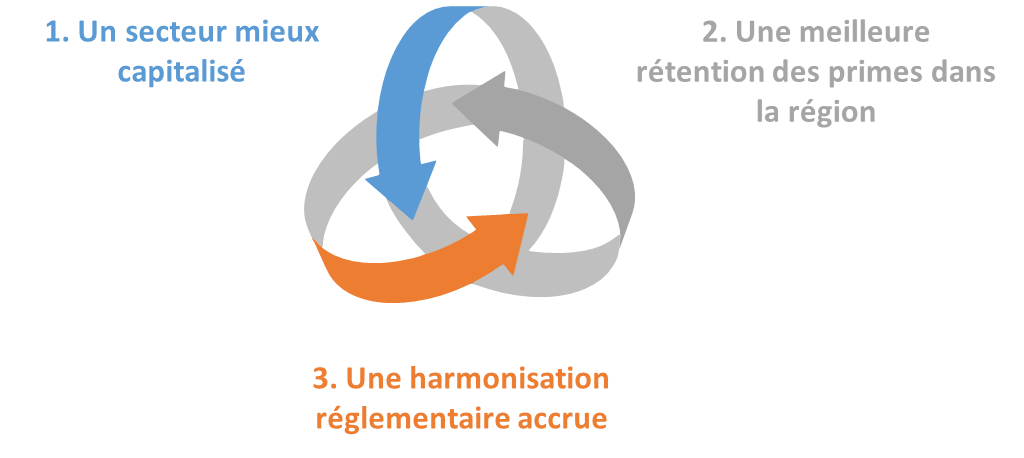
Ten years later, in 2025, I keep coming back to one essential question: have we actually achieved these objectives? The market is certainly more structured, but has it gained in dynamism? Are local reinsurers today capable of absorbing the premiums generated by large-scale infrastructure projects? And above all, is CIMA regulation, particularly Article 308, still suited to market realities?
A successful consolidation, but a penetration rate that remains low
I remember the heated debates in 2016 around raising insurers' minimum capital to FCFA 5 billion. At the time, many predicted a cascade of consolidations, and they were right.
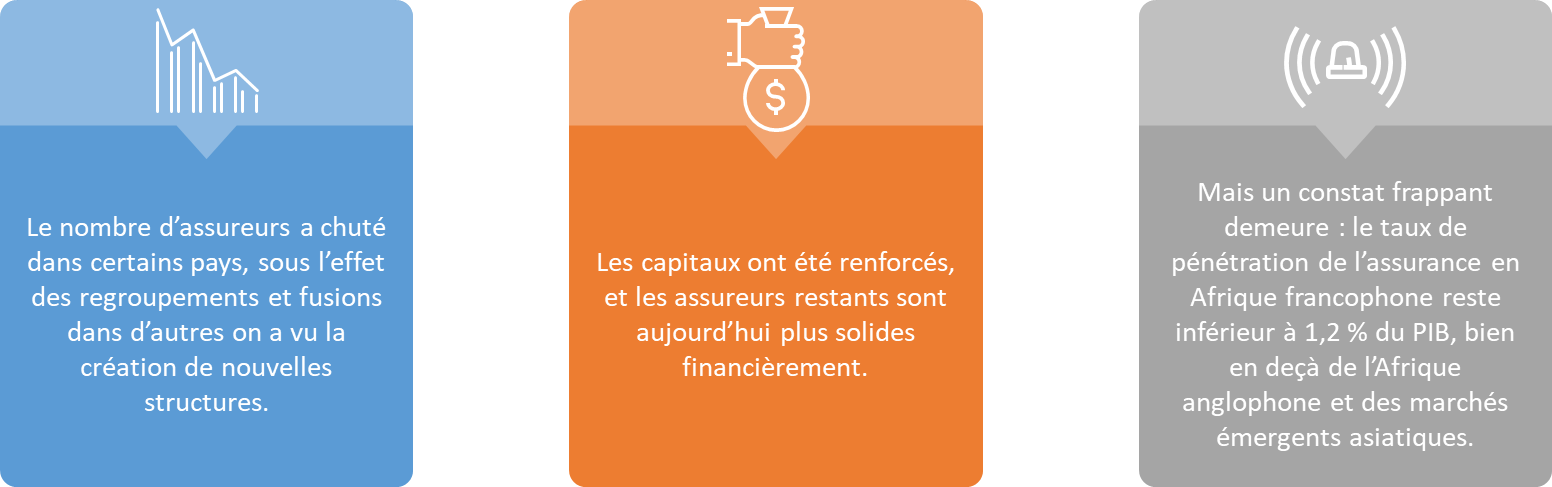
Personally, I believe consolidation was necessary, but it wasn't enough on its own to widen the insurance base. To truly get the market off the ground, reforms will need to go beyond capital requirements and rethink the product offering, in particular by leaning on digitalization.
Major infrastructure projects reshaping the market
Since 2016, I've observed a build-up of infrastructure investment that is changing the game for insurance and reinsurance, notably in Senegal and its neighbors. These initiatives are not only transforming the economic landscape, they are also creating significant opportunities for the insurance and reinsurance sector. Here are a few projects that, in my view, carry a particularly significant impact for the sector:
| Project | Countries involved | Opportunities for insurance |
|---|---|---|
| Abidjan-Lagos Corridor | Côte d'Ivoire, Ghana, Togo, Benin, Nigeria | Construction, transport, liability |
| Nigeria-Morocco Gas Pipeline | Benin, Togo, Ghana, Côte d'Ivoire | Construction, political risk, liability |
| Abidjan Metro | Côte d'Ivoire | Construction all risks, transport |
| Nachtigal Dam | Cameroon | Energy, machinery breakdown |
| 69-project infrastructure programme | Several CIMA countries | Construction, energy, transport |
| Sangomar field development | Senegal | Oil & gas, machinery breakdown, marine insurance |
These projects generate massive insurance premiums, and the question that concerns me is a simple one: are our local reinsurers strong enough to absorb them?
The fragile balance between project costs and reinsurance needs
Given the scale of infrastructure investment across the CIMA zone, it's clear that insurance and reinsurance needs will grow significantly. That said, a cautious analysis is warranted: looking at the current capitalization levels of local insurers and reinsurers, it's apparent that these risks cannot be fully absorbed within the CIMA zone.
Several factors come into play:
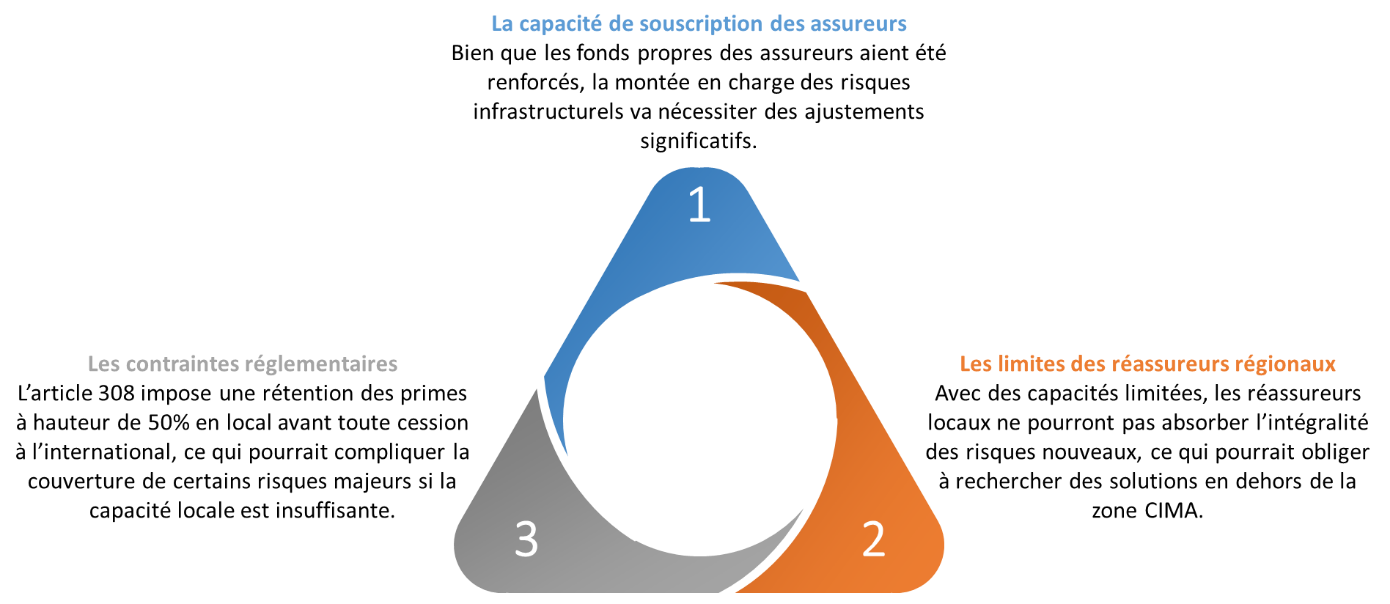
There is therefore little doubt that managing risk in the CIMA zone will require either a recapitalization of local/regional insurers and reinsurers, or greater regulatory flexibility allowing for better diversification of reinsurance placements abroad.
Article 308 of the CIMA Code and its implications
Article 308 of the CIMA Code imposes restrictions on underwriting and reinsuring abroad in order to protect the local market. Among other things, it provides that:
- Any reinsurance cession abroad covering more than 50% of a risk requires authorization from the minister in charge of the insurance sector.
- Certain risks (accident, health, life, etc.) may under no circumstances be reinsured outside the CIMA zone.
- Any violation exposes the insurance company, the intermediary, and the insured to sanctions.
Given current local insurance and reinsurance capacity, and with mega-projects on the way, how can the various CIMA obligations be honored? Looking ahead, we will likely see the creation of new insurance and reinsurance companies, the establishment of new capitalized branches within the zone, as well as capital increases to strengthen existing players. It's also conceivable that we'll see more mergers and acquisitions among local insurers and reinsurers to reach a more robust critical size, or even capital openings to attract new investors and support market development. In this context, it becomes essential to rethink the sector's growth model to secure its long-term sustainability and its adaptation to new challenges.
Building a more robust and sustainable insurance market
The increase in capital requirements is forcing insurers to rethink their growth model and explore new strategies for sustainable profitability. Beyond the major infrastructure projects mentioned above, Africa is also fertile ground for insurance innovation — particularly in digital, cybersecurity, parametric insurance, agricultural insurance, catastrophe risk, compulsory lines, and microinsurance. The rise of these new forms of coverage represents a unique opportunity for market players to diversify their offering and support the economic and societal transformations under way. Several levers can be activated:
A. Expanding distribution channels and financial inclusion
- Bancassurance: partnerships between banks and insurers can boost access to insurance products and widen the customer base. This model, which has proven effective in Morocco, could play a key role in accelerating the penetration rate.
- Mobile insurance and digitalization: with the rise of mobile telephony and digital platforms, integrating digital solutions (mobile payment, simplified underwriting, remote monitoring) could revolutionize insurance distribution.
- Microinsurance and community-based solutions: offering coverage adapted to low-income populations through mutual and collaborative models.
B. Diversifying and modernizing the product offering
- Product innovation: broadening insurance lines (agricultural parametric insurance, cybersecurity, catastrophe risk) is essential to support economic and societal transformation.
- Compulsory insurance as a structuring lever: several lines remain underdeveloped relative to international standards. Among the lines that could be progressively introduced or strengthened: decennial construction liability, tenant insurance, professional liability for certain regulated professions, and agricultural and natural catastrophe insurance.
The digital revolution: new momentum for the sector
In 2016, insurance digitalization in French-speaking Africa was still in its infancy. Today, it is unavoidable, and CIMA has finally taken steps in this direction with its new regulation on insurance digitalization (01/CIMA/PCMA/CE/SG/2024). Since February 2024, all companies must:
- Guarantee the traceability of insurance contracts for 10 years.
- Protect customer data and use electronic signatures.
- Ban insurance credit: payment is mandatory before cover takes effect.
I see this transformation as an opportunity to widen access to insurance, particularly through digital platforms and insurtechs. If companies play their cards right, they could win over new market segments.
Conclusion: a future to build, between challenges and opportunities
Throughout this article, I've tried to shed light on the current dynamics of the insurance and reinsurance sector in the CIMA zone. I've raised questions, explored avenues, and tried to offer a nuanced take on the changes under way and the challenges that remain. While significant progress has been made in structuring and capitalizing the sector, major challenges persist:
- Better capturing the opportunities created by large infrastructure projects.
- Strengthening local reinsurers' capacity to absorb rising premiums.
- Accelerating digitalization to improve insurance product distribution.
- Balancing the prudential framework to secure the market without holding back its growth.
French-speaking Africa, and the CIMA zone in particular, is at a pivotal moment in its development. The market has matured, but its future growth will depend on our ability to reconcile innovation, capitalization, and regulatory adaptation. The prudential framework should not be a brake on growth, but a catalyst for building stronger, more competitive players. Between tighter regulation, growing capital needs, and product innovation, the sector must strike a balance between financial soundness and commercial dynamism.
This debate between regulatory flexibility and rigor should not be seen as a dilemma, but rather as an opportunity to rethink a model better suited to the economic realities of the CIMA zone. The challenge is not to choose between prudence and growth, but to find the right balance that allows local companies to play a leading role in their own market while remaining attractive to investors and new entrants. Innovation, capitalization, and regulatory agility will be the pillars of significant development for insurance and reinsurance across the zone. We are facing not just a turning point, but a historic opportunity. It's not the environment that should dictate how the market evolves, but the ability of its players to innovate, anticipate, and build a sustainable ecosystem. Today's decisions are tomorrow's market foundations, and it's by pushing the boundaries of what's possible that the sector will reach its full potential.