
Why telematics matters to me
Every week, more than 20 people die on Morocco's urban roads, and 126,000 were injured in 2024 alone. Nationally, the toll already stood at 3,200 deaths a year in 2022. In my day-to-day reinsurance work, I see a concrete lever here: telematics.
A global market in full acceleration
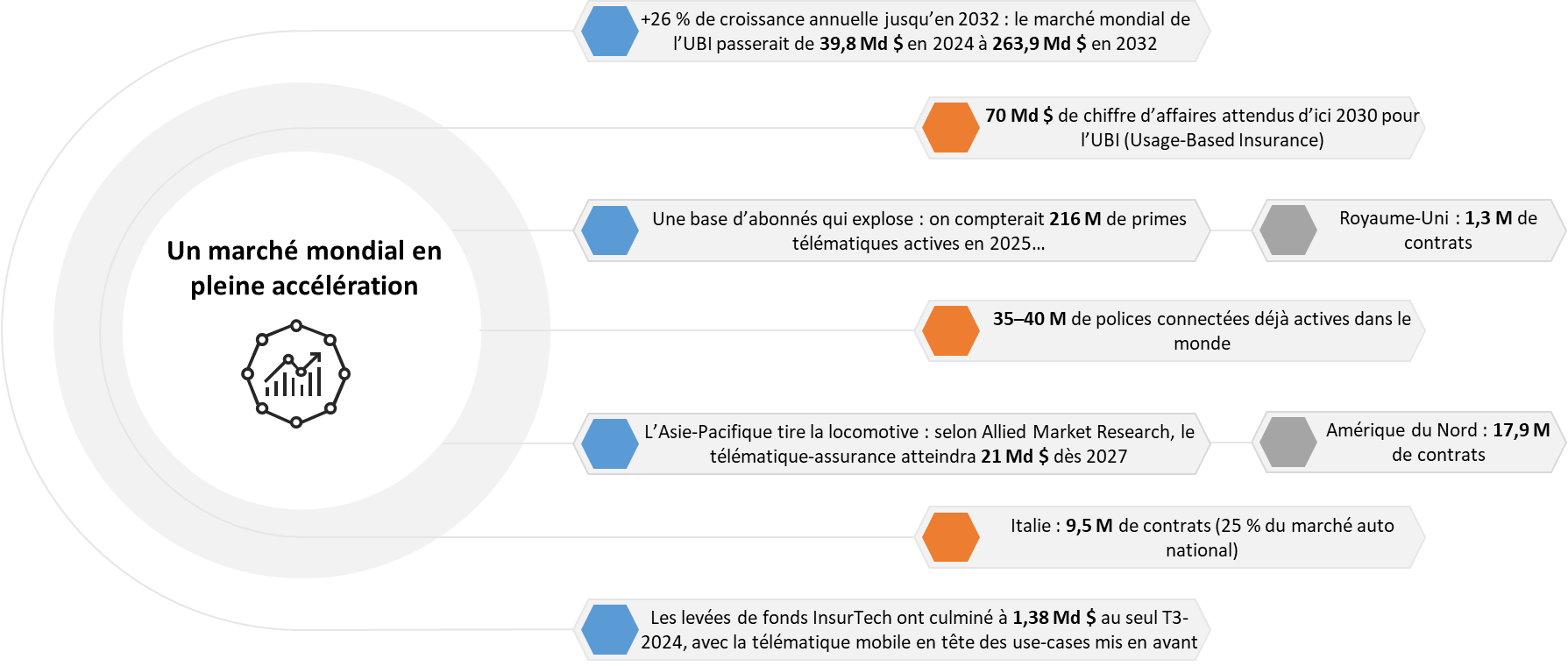
I've noticed that in just a few years, connected car insurance has gone from a niche play to an ultra-dynamic global market. Based on the data I've gathered, here are a few striking indicators of that acceleration:
The four families of solutions
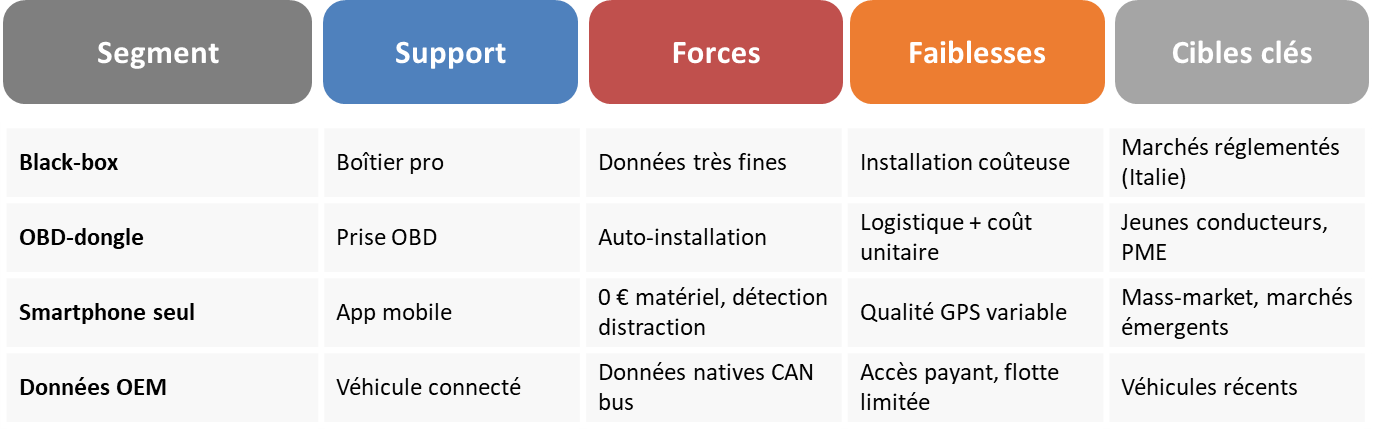
Before comparing players or talking about business models, I first asked myself: what technical architectures really sit behind the word "telematics"? After going through around ten reports (including DriveQuant's Connected Insurance 2025 Guide, available online) and cross-checking them against field experience, I keep landing on the same typology: four distinct families, each with its own strengths, limitations, and target audience. The table below summarizes the framework I now use to position every project, whether a local pilot or a market-wide rollout:
Business models observed
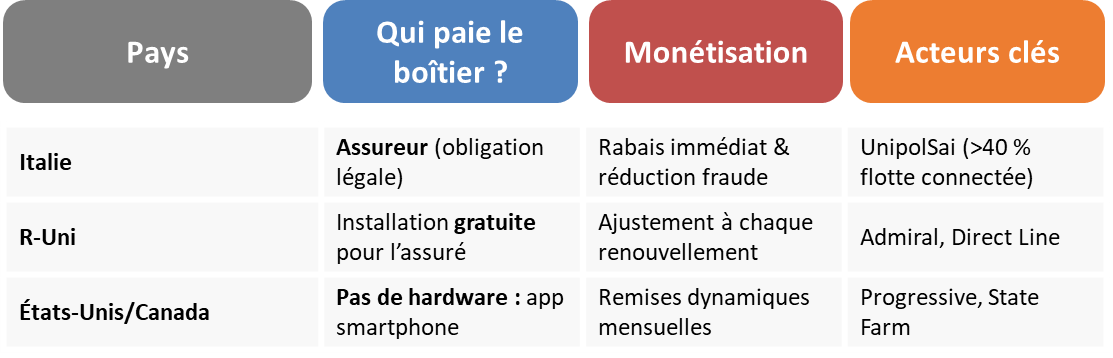
Having broken down the technical architectures, I wanted to understand how each market turns technology into economic value. So I compared three pioneering regions — Italy, the UK, and North America — looking at, for each, who bears the cost of the hardware, the monetization mechanics, and the dominant players. The table below condenses that field analysis: it shows how regulation, insurance culture, and customer acquisition cost shape very different models... that Morocco could adapt or blend depending on its ambitions :)
Economic outcome: telematics programs deliver on average a -50% claims frequency and improve the combined ratio by 15-20 points.
Focus on Morocco: high societal value potential
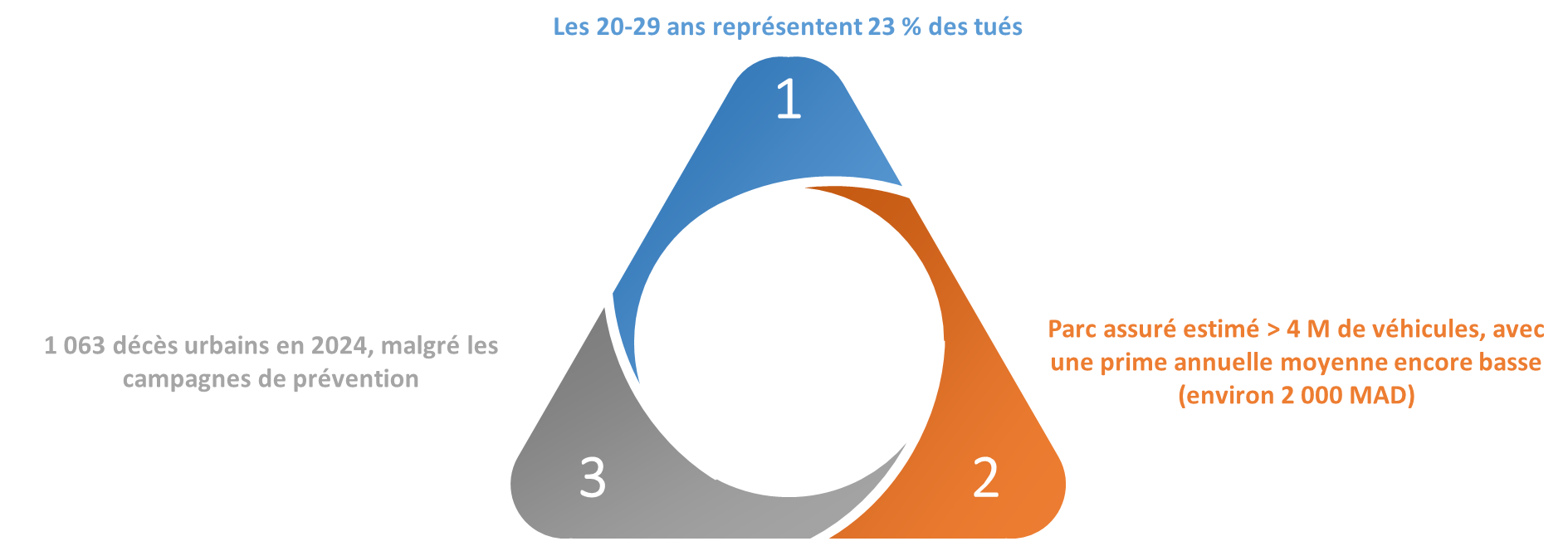
Before imagining connected customer journeys, I looked at our own road-safety reality: 20-29 year-olds already account for 23% of fatalities, a grim indicator that persists despite prevention campaigns. In 2024 alone, 1,063 deaths were recorded in urban areas. At the same time, our motor market counts more than 4 million insured vehicles, but an average premium that barely exceeds MAD 2,000 a year — a level that leaves little room to fund prevention and innovation. Taken together, these three data points show it's urgent to move toward proactive insurance: telematics can precisely reconcile road safety, responsible pricing, and economic viability.
My opportunity scenario
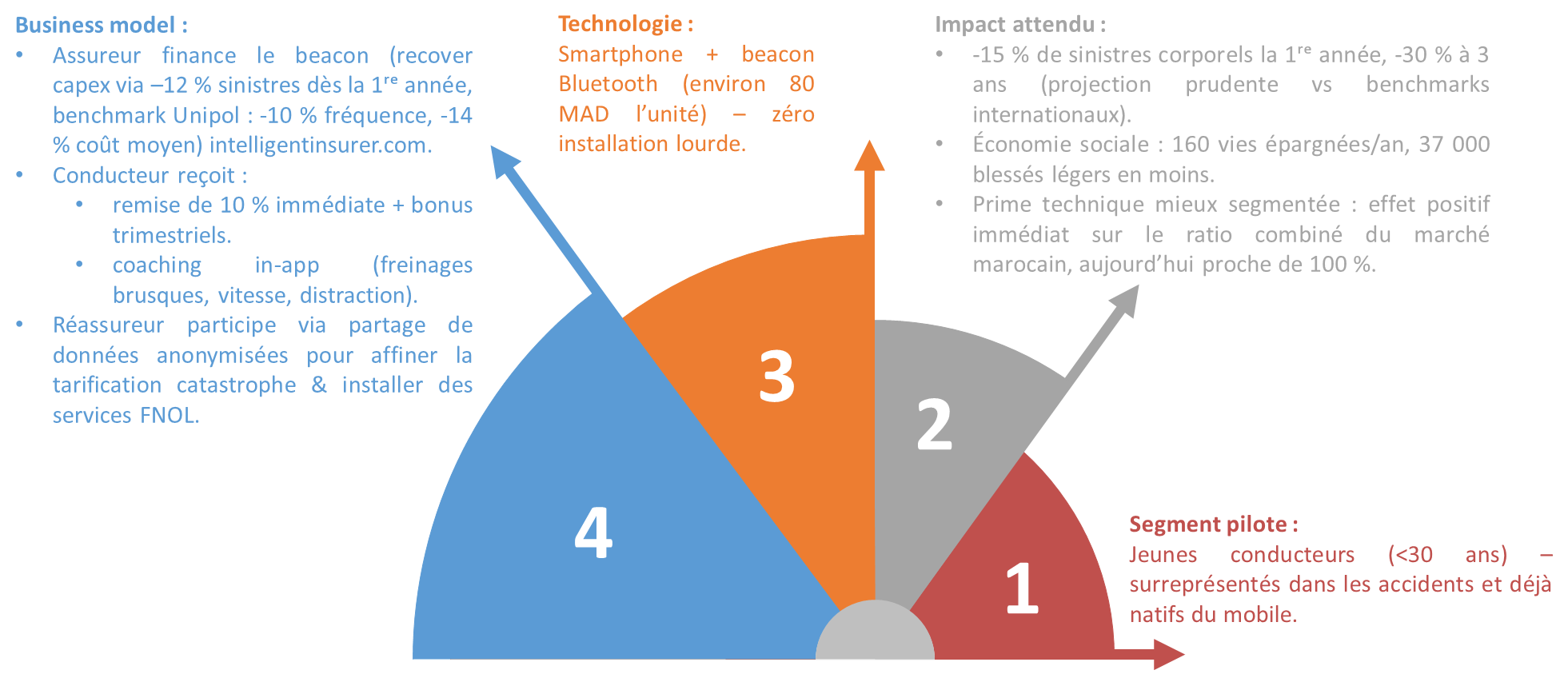
I long wondered why the first telematics trials launched in Morocco between 2017 and 2019 never took off: devices were installed by default, drivers felt under constant surveillance, and installation remained costly for the insurer. Building on that observation, I've now steered my opportunity scenario toward something voluntary and rewarding. I first target drivers under thirty, over-represented in accidents but already inseparable from their smartphones. In the benchmark, we saw that North America is already shifting to "smartphone only" because it removes the cost of a device. I take that same logic, but I add a beacon — a small, low-power Bluetooth transmitter, about the size of a coin, costing barely MAD 80, that sticks onto the windshield: it confirms the phone is actually in the car and makes tracking reliable without a garage visit. The insurer funds this micro-capex, quickly amortized through lower claims. The driver, in turn, gets a discount and quarterly bonuses, potentially convertible into free months of Spotify or another platform to anchor usage. The reinsurer, for its part, benefits from richer data to refine the scheme: the app automatically detects a crash, sends the alert, and thereby lowers the average claim cost. In other words, we keep the accessibility of the North American model, remove the technical friction that doomed the first pilots, and create a value chain that works for every stakeholder. Above all, this lasting drop in claims frequency and severity directly improves the solvency ratio: every point of loss ratio saved frees up capital, reduces the consumption of own funds, and strengthens the solvency margin — offering greater protection to policyholders and shareholders alike while freeing up capacity to fund growth.
Let me elaborate: starting from the 3,499 road deaths recorded in 2022, of which 23% involve 20-29 year-olds (roughly 800 victims), I use three assumptions:
- Measured telematics effectiveness: Unipol's "black-box" programs in Italy cut accident frequency by 20-30%. In the UK, connected insurance reduced deaths and serious injuries among young drivers by 35%. I use a conservative -30% for every driver actually connected.
- A realistic adoption curve: 25% of 20-29 year-olds equipped in year one, 50% within three years.
- A halo effect: in-app coaching accounts for a further -10% to -12% in claims among monitored drivers, and positively influences even those not equipped.
Applied to the segment's 800 annual deaths, this would translate into roughly 60 lives saved in the first year, then more than 160 lives saved every year once the program matures — not counting the thousands of injuries avoided. The lasting drop in claims frequency correspondingly frees up capital charge (SCR/SBR), improves the combined ratio, and gives the Moroccan market more room to fund innovation and prevention... and, this time, all the conditions are in place for telematics to finally take root in Morocco :)
Conclusion
Surveying the global market, from Italy's black-boxes to North America's fully mobile apps, I wanted to show that telematics is no longer a trend but a standard in the making. I reviewed the four technical architectures and the business models that carry them, then confronted these lessons against our Moroccan reality: a massive vehicle fleet, still-low premiums, and, above all, too many young victims on the road. That's where my pilot scenario comes from: a simple Bluetooth beacon, a fully opt-in journey, dynamic discounts, and lifestyle partnerships to convert road-safety caution into real value for the policyholder, the insurer, and the reinsurer.
I'm well aware this is only a sketch — pricing, the contractual framework, data governance, and field testing all still need refining. But I'm convinced that, given our market's regulatory maturity, its technical discipline, and players' appetite for innovation, this model can take off — provided there's collective will behind it.
References & further reading
For those who want to dig deeper, here are the main sources behind this analysis, organized by theme:
UBI market size & growth
- MarketsandMarkets — Usage-Based Insurance Market, Global Forecast 2024-2030
- DriveQuant — Connected Insurance 2025 Reference Guide
International volumes & business models
- Businesswire / ResearchAndMarkets — Insurance Telematics in Europe and North America Report 2025
- PTOLEMUS Consulting Group — Will Italy mandate telematics in insurance?
- Admiral UK — Black-Box Car Insurance product page
Safety & loss impacts
- RoadSafetyGB — Black-box technology significantly reduces young-driver crashes
- Wikipedia — "Trials conducted by Norwich Union" section (-20% accidents among 18-23 year-olds)
Morocco data
- NARSA — 2022 Road Safety Report (3,499 deaths)
- SNRTNews — Worrying rise in road deaths in Morocco in 2024 (4,024 provisional deaths)
Beacon technology & costs
- Pointr — Bluetooth beacons: Everything you need to know (price $15-35 ≈ MAD 150-350)
- Supplier example (unit price ~$3-8)
Feel free to check out these documents: they provide the data context and use cases behind my Moroccan scenario.